Ka ora, ka ora
Ka mate, ka mate
Ka ora, ka ora
Tenei te tangata puhuruhuru
Nana i tiki mai whakawhiti te ra
Upane, upane
Upane kaupane
Whiti te ra
Haka of Te Rauparaha, chief of Ngati Toa tribe (1768-1849)
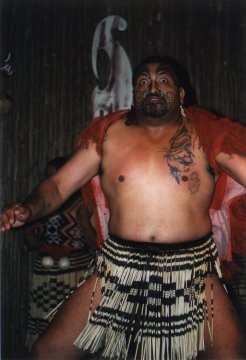
| Ka mate, ka mate
Ka ora, ka ora Ka mate, ka mate Ka ora, ka ora Tenei te tangata puhuruhuru Nana i tiki mai whakawhiti te ra Upane, upane Upane kaupane Whiti te ra Haka of Te Rauparaha, chief of Ngati Toa tribe (1768-1849) |
|
|
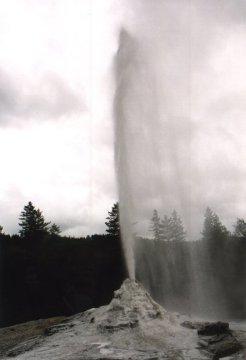
South of Rotorua, Waiotapu (meaning sacred waters in Maori language) is one of New Zealand's best thermal areas to visit. One of its main attractions is the Lady Knox Geyser which goes off every day at 10.15 am exactly. While this may seem one of nature's miracles it's just a matter of throwing a couple of kgs of soap in to the Lady. |
| Napier (and neighbouring Hastings as well) has a very architecturally rich city centre. This is a direct result of the devastating eartquake that hit the area in 1931. Due to the quake and the subsequent fires Napier was left without a city centre. Franctic reconstruction followed resulting in an architecture that dates from the peak years of Art Deco. | 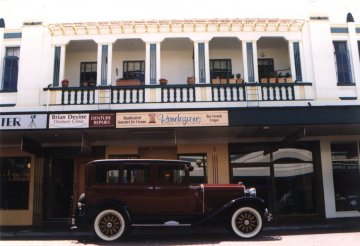
|
|
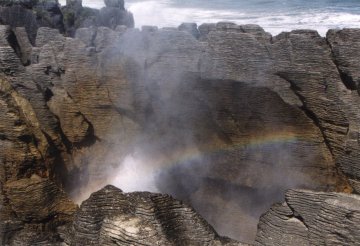
Punakaiki is most famous for it's Pancake Rocks and Blowholes. Over a period of eons the limestone rocks have weathered into shapes that resemble pancakes. At high tide the waves of the sea are pushed through caverns below the rocks and squirt out in impressive blowholes. |
| Frans Jozef Glacier is one of New Zealand's major tourist attractions. Franz Josef Glacier (and Fox Glacier a few kms to the south) almost reaches sea level, a phenomenon not seen in other places at this lattitude. A combination of the Western Alps only a few kms inland and the prevailing rain-laden westerlies results in a lot of snow falling high up in the névés. This accumulation of snow flows down the steep slopes as a mighty river of ice. The glacier's velocity is also remarkable. It moves with an average velocity of 1 m per day, almost 10 times as fast as glaciers in the Swiss Alps. | 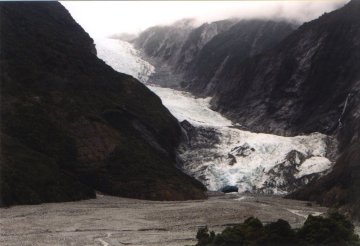
|
|
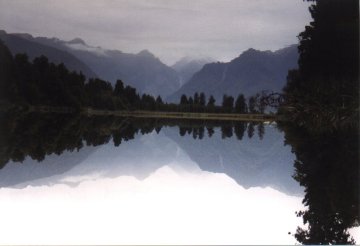
Lake Matheson is one of New Zealand's most famous panoramas. Early in the morning the surface of the lake is at its most mirror-like calm. Together with a blue sky and the snow capped Western Alps the sight is unforgettable. Unfortunately the skies are not always blue. |
| What's New Zeland without its sheep? | 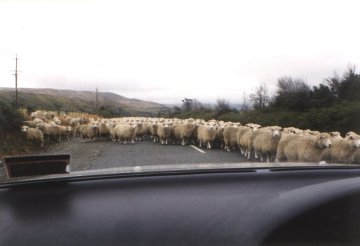
|
|
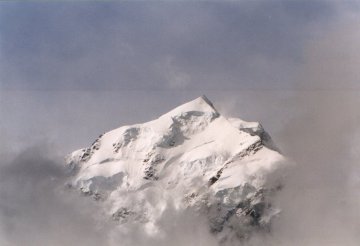
Mount Cook National Park accounts for 22 of New Zealand's 27 mountains higher than 3000 m. With 3755 m Mount Cook is the highest of them all. Aoraki, as the Maori call it, was first climbed on Christmas Day in 1894. Sir Edmund Hillary used it to practice his skills. |