A brilliant sun wakes us as it shines through the windows of the car. Although we slept reasonably well, sleeping inside a car won't become our favorite way of spending the night. The wet tent is spread out in the back of the car and after breakfast we leave for our first destination. Muriwai Beach, about 50 km away on the West Coast. Rush hour is a far cry from the heavy traffic we're used to and it becomes even lighter when we take de SH18 away from Auckland. At about 9 a.m. we reach Muriwai Beach.

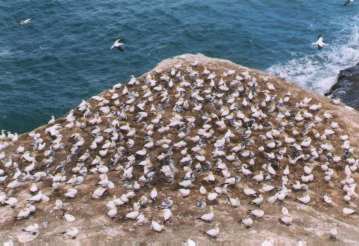
Muriwai Beach and its colony of Australasian gannets.
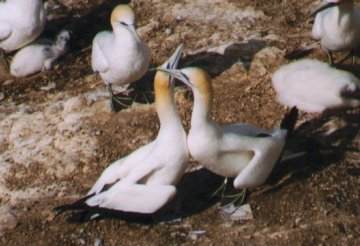
Two courting gannets..
Two courting gannets.
The main attraction at Muriwai Beach is its colony of Australasian gannets. Once confined to an isolated rock in front of the shore, the colony has expanded to the shore cliffs and can be approached at reasonably close range. Hundreds of birds, including chicks, can be seen. Down below huge waves break on the cliffs trying to wash away several fishermen. We spend an hour here before continuing to the Kauri Coast.

The Kauri Coast is so-called because of the Kauri timber and gum industry that brought much wealth to the area in the 19th century. The native Kauri trees can grow over 2000 years old and can grow up to about 60 m with a trunk diameter up to about 5 m. Unfortunately extensive logging has stripped most of the area of its massive kauri forests that stretched north from Kaipara Harbour till Hokianga Harbour, a distance of about 150 km. To get a better insight in the kauri industry and its impact on the local communities, we visit the Pioneer & Kauri Museum in Matakohe. This neat museum has a large photographic collection and a number of lifelike displays showing various aspect of every day life of the kauri bushpeople.
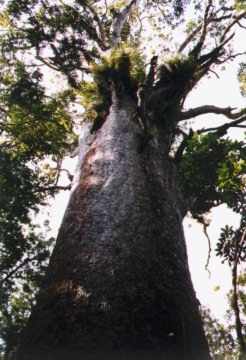
Te Matua Ngahere, father of the forest.
The Four Sisters.
The Four Sisters. Watch for Petra at the base!
After visiting this great museum it's time to see the trees in the wild. It's about 4 p.m. when we reach the best place for that: Waipoua Kauri Forest. Waipoua is New Zealand's largest remnant of the once extensive kauri forests. Proclaimed a sanctuary in 1952 all milling of kauri trees is prohibited except for very exceptional circumstances (e.g. the carving of a Maori canoe). The road through the forest already shows us some huge kauris but we definitely want more.

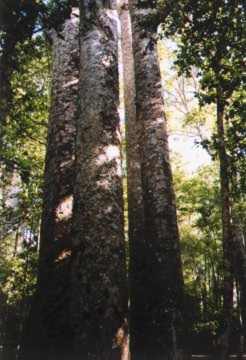
We first take the gravel road to the forest lookout, originally a fire lookout giving us a spectacular view over the surroundings. But then we really want to see the big ones. A short walk from the car park brings us to Te Matua Ngahere, the 'father of the forest', having a trunk over 5 m in diameter. Close by are the Four Sisters, four tall trees in close proximity. Further up the road we visit Tane Mahuta, 'lord of the forest', the largest Kauri in New Zealand and an estimated 1200 years old. At 52 m it's much taller than Te Matuha Ngahere but it doesn't have the same impressive bulk.
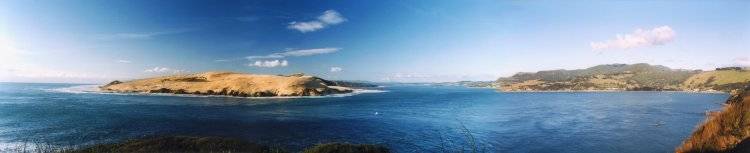
North Head, Hokianga Harbour.
Hokianga Harbour as seen from Signal Station Point.
As it's already 6 p.m., we skip our plan to reach Paihia today, and decide to camp at Omapere, situated at Hokianga Harbour. Two km west of Omapere, a small road leads to a lookout at the South Head of Hokianga Harbour. A five-minute walk from the car park brings us to Signal Station Point where we have a spectacular view over Hokianga Harbour, the massive sand dunes of North Head and the turbulent confluence of the harbour and the open sea.

The campsite at Omapere is a nice and quiet place. Again we're surprised by the facilities (kitchen with furnaces, toilets with toilet paper, washing machine and drier, etc.). Unfortunately the views at the harbour are less spectacular than those at Siganl Station Point and after a short stroll we turn in. Fortunately no rain tonight!

YesterdayTomorrow