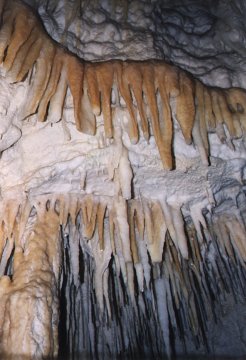
Stalactites hanging from the ceiling inside Aranui Cave.
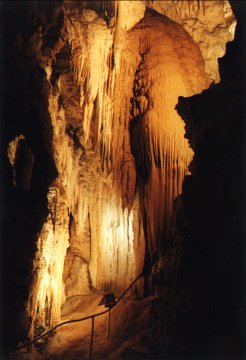
Illuminated formations in Aranui Cave.
|
Stalactites hanging from the ceiling inside Aranui Cave. |
Illuminated formations in Aranui Cave. |
The Aranui Cave lies 3 km further up the road from Waitomo Cave. This cave has no river running through it hence no Glowworms are present. So contrary to Waitomo Cave, where photography is not permitted in order to keep the disturbance of the Glowworms to a minimum, photographs can be taken freely. Aranui Cave is a large cave with thousands of stalactites hanging from the ceiling and stalagmites pointing upward. Some formations are beautifully illuminated. Unfortunately tourists have damaged in a few seconds what nature has taken thousands of years to grow and many features are fenced of nowadays.
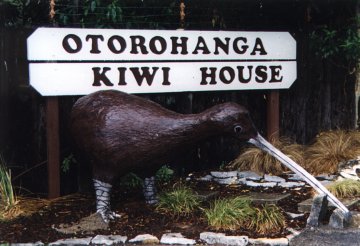 The Kiwi House at Otorohanga. |
After our visit to the Aranui Cave we head north again to Coromandel. Our destination is Hot Water Beach. On our way there we pass through Otorohanga a small village where a long time ago a Maori chief carrying little food was able to make the food last for his entire journey by magic incantations (Otorohanga means "food for a long journey" in Maori language). Apart from the local stock and farm auction, the biggest in the King Country, Otorohanga is interesting only for it's Kiwi House. In an enclosure where day and night are reversed, two Kiwi's can be seen walking around. Apart from that Otorohanga has New Zealand's largest aviary and many other interesting native animals like keas, wekas and tuataras. |
Late in the afternoon we arrive at Hot Water Beach Holiday Park. Hot Water Beach is called so because two natural hot springs surface at the beach just above the low tide mark. According to the tide-table we have to get up early to fully appreciate this phenomenon: 4.45 am. So a quick meal and early to bed.

